VDI for engineering teams and contractors: still worth it?
VDI promised centralised CAD workstations for secure collaboration with contractors and distributed engineering teams. But with Citrix and VMware price hikes, is the "private jet" model still worth it?



VDI for engineering teams and contractors: still worth it?
A decade ago, I led a team at a joint venture between Atos, VMware, and EMC. We built and sold VDI solutions to makers of planes, trains, and automobiles for their CAD and BIM applications. We believed we were solving a real problem for engineering teams, and for a while, it did.
After bringing this to market, I left for a great career opportunity at PTC, but this experience planted a seed which ultimately forced me to make a dramatic decision.
Why? I'll get to that, but first let me tell you what I've come to understand about what we built back then and why the world has changed.
The promise
Engineering looked different ten years ago. Your own people were at headquarters, your contractors were somewhere else, your client's security team wanted assurances that data never left your building, and you needed a way to make it all work.
Citrix had been around for a while, but for engineering teams it was useless because the 3D applications -Siemens NX, Solidworks, Revit, AVEVA E3D, Smart 3D, CADWorx - needed serious graphics horsepower that remote desktops couldn't deliver.
Then, around 2012-2013, something changed. Citrix added GPU support, and suddenly you could run demanding CAD applications in a data centre and stream them to users anywhere. VDI for engineering was born.
One centralised environment where everyone connects remotely, data stays where it belongs, and when the project ends, you revoke access and you're done. We sold this to companies building planes, trains, and automobiles, and they bought it because it solved real problems - so what changed?
What we were also selling
I didn't see it at the time, and neither did anyone else on the team. The VDI solution to the collaboration problem we sold was like a private jet - only available for the very largest companies who could afford it.
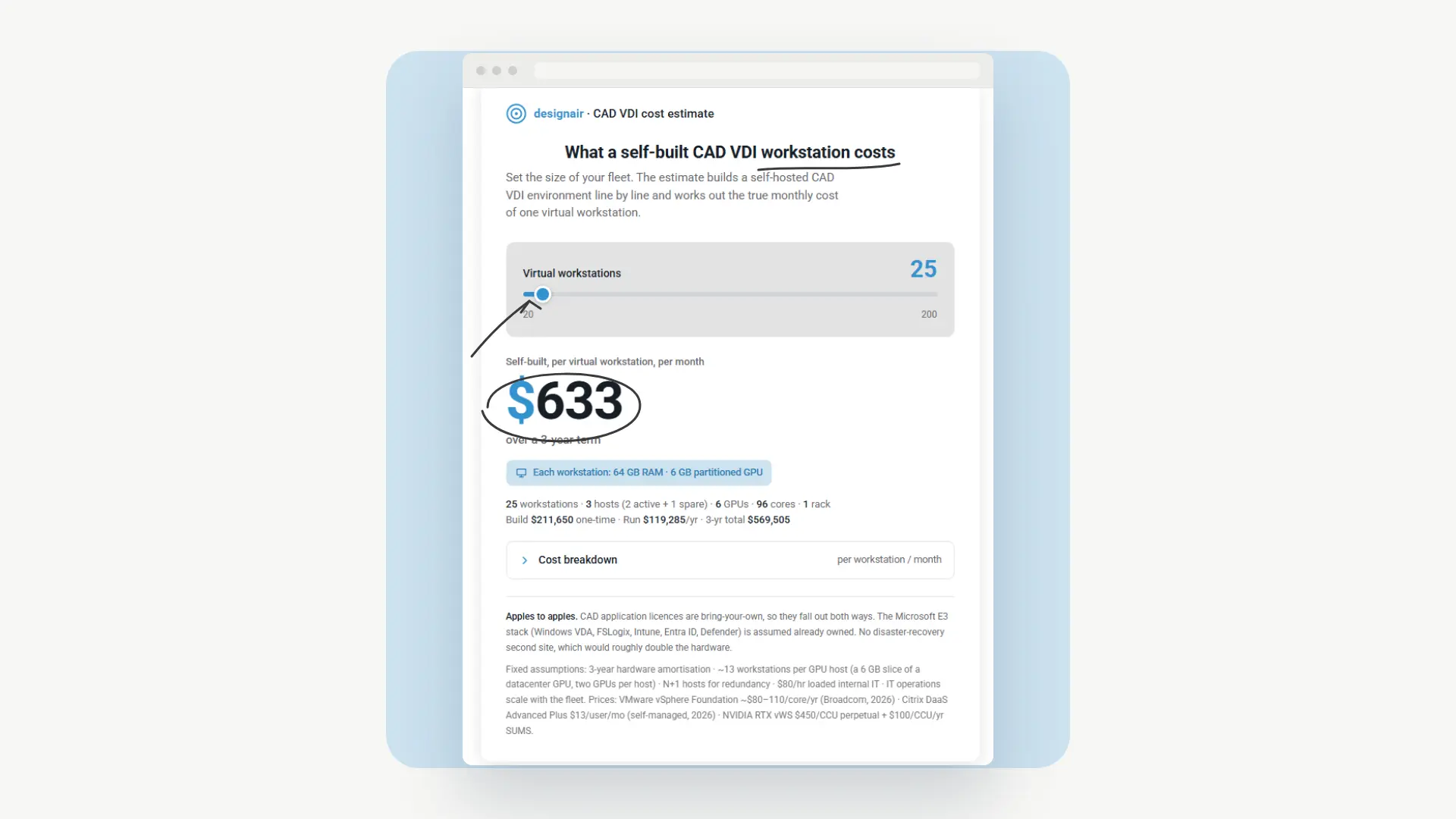
When you invest in VDI, you're buying the whole operation: the infrastructure, the specialists to run it, the ongoing maintenance, the hangar fees, the fuel, and the crew on retainer.
And just like a private jet, it works - you control everything, you fly on your schedule, with no queues and no compromises. That is, if you can afford it.
A lot has changed
That was then, and here's what's happened since - besides COVID.
In 2022, Citrix was acquired by Vista Equity Partners and Elliott Management for $16.5 billion. In 2023, Broadcom acquired VMware for $61 billion.
These weren't technology companies looking to innovate - these were financial investors looking to extract value.
The playbook is familiar: consolidate products into bundles, eliminate perpetual licenses, force everyone onto subscriptions, and raise prices. VMware customers report price increasesranging from 2x to 12x depending on which products they use, and AT&T claimed Broadcom offered them a 1,050% price increase.
Citrix followed a similar path. Reports suggest that the cost of certain software licenses has doubled, particularly for customers who don't commit to annual payments upfront, and customers report licensing cost increases of 50% or more with as little as 90 days notice before renewal.
The jet you bought? The new owners just tripled the hangar fees, and there's nothing in the contract that says they can't do it again next year.
The question I kept asking myself
While I was at PTC, I couldn't stop thinking about how to build a solution that solves that exact same problem - distributed engineering teams, external contractors, data that needs to stay protected - but this time for companies of all sizes?
This was before the price hikes and the private equity games. I was wondering: is a private jet still the right answer?
I came to the conclusion that it wasn't - here's why.
Why I concluded the private jet model is broken
Performance is mediocre
When I thought about how to make VDI accessible to everyone, I had to face an un comfortable truth: the only way to make the private jet affordable was to oversell tickets and cram more seats in there. Squeeze more users onto the same infrastructure to bring down the per-seat cost. And because the upfront investment is so high, I couldn't afford to refresh the hardware after three years - I would have to stretch it to five, or even longer.
That's exactly why the VDI experience is so often disappointing. The private jet flies with old engines and the legroom of economy class.
Only works within 500-800 km
Then I had to think about where to park the jet. VDI lives in a data centre - probably one data centre - and physics is unforgiving because latency kills 3D performance. Beyond 500-800 km, engineers are fighting the connection, not the model.
I could build the most beautiful private jet in the world, but it would only work if everyone lives near the hangar.
Big upfront capital investment
Before the private jet even would have taken off for the first time, I would have had to spend millions on the aircraft, the crew on retainer, and the maintenance contracts - and I wouldn't have gone anywhere yet.
If I had wanted to build aVDI-based solution, I would have had to raise something like 10 to 20 million just to get started. All I wanted was to help engineering teams get from A to B, but building this plane would have required a fortune before a single passenger could board.
Here's an anecdote that confirms this was a flawed idea: Cloudalize raised over 20 million to build a VDI-based cloud workstation service for CAD applications. In March 2024, they were acquired by Radian Arc, who promptly pivoted the business away from remote desktops towards cloud gaming and AI infrastructure. Even 20 million wasn't enough to make the VDI model fly.
Complex to set up
A private jet doesn't just show up ready to fly - there's crew training, flight planning, maintenance schedules, fueling arrangements, insurance, and regulatory compliance to sort out first.
If I had built a VDI solution, I would have had to figure out networking, storage configuration, GPU passthrough, hypervisor tuning, user provisioning, security policies, and testing before a single customer could use it. That takes months, sometimes longer, and I would have needed people who know what they're doing - people who are expensive and hard to find.
I would have bought the jet, and then spent a year figuring out how to fly it.
Zero scaling
Earlier I mentioned cramming too many passengers onto the jet to justify the cost, and that's because the jet doesn't get bigger.
If I had sized my VDI for a certain capacity, and then grown quicker than planned, I would have had to turn down and disappoint new customers.
Or the opposite: the market slows down, half the customers leave, and I'm still paying for infrastructurethat's sitting idle because I can't give it back. That's bankruptcy.
The jet is the size it is - too crowded when times are good, too expensive when times are quiet.
Requires specialised skills to run
You don't fly a private jet yourself: you need pilots, mechanics, and people who understand the systems.
Setting up VDI is one thing, but keeping it running is another. Every day there's patching, troubleshooting,vendor updates, performance tuning, and firefighting when something breaks. That requires dedicated people, and those people become a single point of failure. When they leave - and they always leave eventually - they take everything they know with them.
I would have bought a jet, but then I would have needed to staff a whole team just to keep it in the air.
Is it even certified?
Without certification, you're not allowed to fly in most airspaces - doesn't matter how good your jet is, because no papers means no permission.
If I had built my own VDI infrastructure, I would have to invest in certification just in case a client asked for ISO 27001, SOC2, or NIS2.
The choice is either I'm not certified and I can't serve most customers, or I've gone through the massive pain and cost of certifying every single nut and bolt of my own DIY infrastructure - and next year I get to do it all over again to maintain it.
I would have bought the jet, but half the destinations wouldn't have let me land.
The public airline
So here's how the story ends. That seed I mentioned at the start never went away. It stayed with me through my years at PTC, turned into a passion. Eventually I left my secure, comfortable and well-paid executive job to co-found Designair at the tender age of 54. Now at Designair, we have built our unique solution. We started from scratch on top of a hyperscaler and designed it to offer our clients - SMB's, mid-market companies and enterprises - a public and secure desktop-as-a-service for CAD and BIM applications. This service is built with the 5 characteristics of cloud computing (according to NIST): self-service, on-demand, available from anywhere, pay for what you use, and shared (hyperscaler) infrastructure. And you bet it beats VDI, and matches the performance of your on-premise workstations.
But don't take my word in it, and convince yourself. I'd like to offer you a free flight to a destination of your choice. Pick your application - AVEVA E3D, Smart 3D, CADWorx, whatever your team runs - and see what it feels like to just get to work, no hangar required. Click to get started today.